
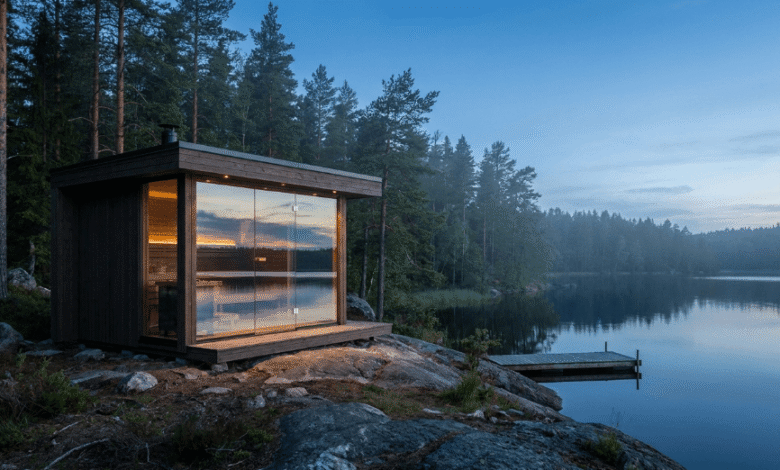
A complete outdoor sauna project has four cost categories: the unit itself, electrical work, foundation or site prep, and ongoing operating costs. For a common 2-person electric barrel sauna, expect roughly $3,000 to $5,000 for the unit and $1,300 to $4,000 more for installation and site work, putting a realistic all-in budget between $4,500 and $9,000 for a straightforward backyard install.
How much does the sauna unit itself cost?
Unit pricing scales mostly with size and wood grade. A 2-person barrel with a kiln-dried spruce shell and a basic 4.5 to 6 kilowatt electric heater typically lands in the $3,000 to $5,000 range. A 4 to 6 person cabin model, larger shell, more glass, a bigger 6 to 8 kilowatt heater, commonly runs $6,000 to $10,000. Premium builds with Western red cedar, upgraded glass doors, or a wood-fired stove option instead of electric can push past $12,000. These are unit prices only, before any delivery, electrical, or site costs are added.
Do accessories and upgrades change the total meaningfully?
Base unit pricing usually reflects a standard configuration, and it is worth checking what counts as standard before comparing two listed prices directly. Upgraded glass, a larger window package, a backrest kit, or a premium heater with a digital control panel can each add a few hundred dollars individually, and stacking several of these upgrades on a mid-range cabin can meaningfully close the gap toward the next size class up. None of these are necessary to get a functional sauna, but budgeting an extra 10 to 15 percent above the base sticker price for accessories is a realistic buffer for most first-time buyers.
What does electrical work actually run?
For electric-heater models, running a dedicated 220 to 240-volt circuit from the main panel to the sauna site is usually the single largest installation line item outside the unit itself. Expect $500 to $1,500 for a straightforward run of 30 to 50 feet, more if the site is farther from the panel, requires trenching under a walkway or driveway, or needs a subpanel. A licensed electrician should always handle this work, both for safety near what is effectively a wet, high-heat appliance and because most heater warranties require professional installation to remain valid.
What does the foundation and site prep add?
A compacted gravel pad is the least expensive foundation option, often a few hundred dollars in materials plus a weekend of labor if done yourself. A poured concrete pad offers a more permanent, perfectly level base but commonly runs $1,000 to $3,000 depending on size and local labor rates. Building onto an existing deck can be the cheapest option of all if the deck’s load rating and access already support it, though a structural check is worth the cost before assuming an existing deck can carry the added weight.
Where can you compare current unit prices directly?
Because unit price varies so much by size, wood species, and heater type, comparing published prices across several current models before budgeting the rest of the project is worth the time. the SweatDecks catalog lists current unit pricing by size and heater configuration, which is a reasonable starting point for estimating the unit cost line before getting electrical and foundation quotes specific to your site.
Does delivery add a separate cost?
Freight is often quoted separately from the unit price, and it is easy to miss when comparing sticker prices across brands. A palletized barrel or cabin kit shipped via freight carrier commonly adds a few hundred dollars depending on distance from the distribution point, and some listings price this in while others list it as an add-on at checkout. Curbside delivery is standard; getting the crated kit from the curb to the actual install site, especially if that is a backyard corner without vehicle access, is usually the buyer’s responsibility unless a white-glove delivery option is purchased separately. Factoring this in before ordering avoids an unpleasant surprise on the final invoice.
What ongoing costs come after installation?
Electric heaters add a measurable amount to a monthly power bill with regular use, generally more noticeable in colder climates where sessions run longer and more often. Wood-fired units trade that for an ongoing wood supply cost, which varies widely by region and how the wood is sourced. Heater stones in either type wear down and typically need replacement every one to three years depending on use frequency, and the wood exterior benefits from periodic sealant or oil treatment to hold up against weather over time. None of these ongoing costs are large individually, but they add up over several years of regular use and are worth factoring into a realistic total cost of ownership.
Is the investment worth it, based on the evidence?
Regular sauna use has a reasonably solid observational research base behind it. A Mayo Clinic Proceedings review of Finnish cohort data found frequent sauna bathing associated with lower cardiovascular mortality, and a review published in The American Journal of Medicine described a broadly favorable risk profile for healthy adults, alongside real contraindications, unstable angina, recent heart attack, and pregnancy among them, that anyone with a relevant condition should discuss with a doctor. As with any home improvement, the honest framing is that this is an association from population studies, not a guarantee for any one individual, and the value of the purchase also depends heavily on how often the household will realistically use it once the novelty wears off.
Frequently Asked Questions
How much does a small outdoor sauna cost total, unit and install?
A 2-person barrel sauna with electric heater typically runs $3,000 to $5,000 for the unit, plus $800 to $2,500 for electrical work and site prep, putting an all-in total commonly between $4,000 and $7,500.
Is electrical work the biggest hidden cost?
For most electric-heater installs, yes. Running a new dedicated 240-volt circuit from the main panel to the sauna site often costs $500 to $1,500 depending on distance and whether trenching is required, and it is easy to underestimate before getting a quote.
Does a wood-fired sauna avoid the electrical cost entirely?
It avoids the heater circuit, since the stove needs no power, but most owners still want a small circuit for interior lighting, so the electrical savings are real but usually partial rather than total.
What foundation costs should I budget for?
A compacted gravel pad is the least expensive option, often a few hundred dollars in materials and labor, while a poured concrete pad or a new deck section can run well over $1,000 depending on size and local labor rates.
Are there ongoing costs after installation?
Yes. Electric heaters add a measurable amount to a power bill during regular use, wood-fired units need a recurring wood supply, and heater stones typically need replacement every one to three years depending on use frequency.
References
- Cardiovascular and Other Health Benefits of Sauna Bathing: A Review of the Evidence, Mayo Clinic Proceedings, 2018. https://pubmed.ncbi.nlm.nih.gov/30077204/
- Benefits and risks of sauna bathing, The American Journal of Medicine, 2001. https://pubmed.ncbi.nlm.nih.gov/11165553/
- Clinical Effects of Regular Dry Sauna Bathing: A Systematic Review, Evidence-Based Complementary and Alternative Medicine, 2018. https://pubmed.ncbi.nlm.nih.gov/29849692/