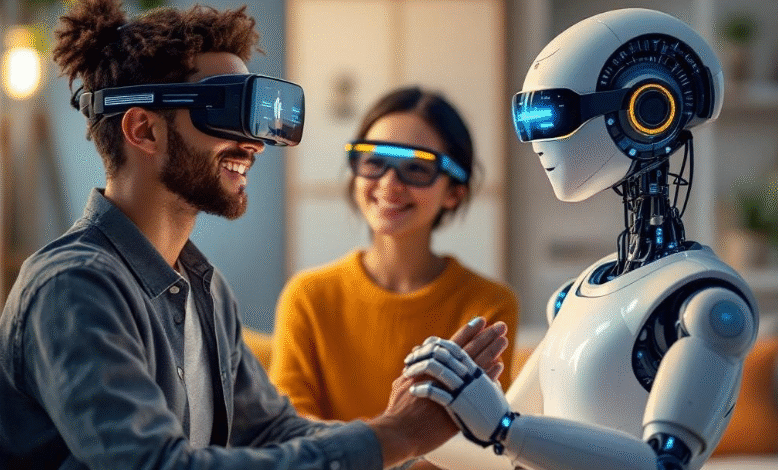
Robotics can be imagined as a vast theatre stage where intelligent performers move through complex settings. Instead of spotlight, makeup, and rehearsed dialogue, these performers rely on sensors, motors, and adaptive reasoning. They do not simply learn patterns on screens. They feel the weight of objects, sense resistance from surfaces, and interpret the world through touch, motion, and context. This is the essence of embodied agents, and in this world of physicality even agentic AI training becomes a rehearsal environment where machines practise skills before stepping into real scenarios.
The World as a Dynamic Playground
Picture a child exploring a new playground. They climb ladders, test balance beams, push swings, and experiment with slides. None of it comes from instruction manuals. It comes from interacting with objects and learning through motion. Embodied agents must behave in a similar way. They must understand the world by acting in it, testing it, and adjusting their behaviour based on results.
Robots built on this philosophy cannot rely on static rulebooks. The real world shifts constantly. A floor may be slippery one moment and dusty the next. A box may be heavier than expected. A corridor may be blocked by a chair. Designing agents that interpret these nuances calls for a mixture of perception, prediction, and continuous feedback. This is where designers invest in structured learning cycles that complement real world exploration with simulation driven practice powered by advanced agentic AI training frameworks.
The Role of Physical Context in Intelligent Behaviour
Embodied agents excel when they understand that intelligence is not separate from the environment. The context shapes the action. The action shapes the outcome. The outcome informs the next step. This loop determines how robots interact with surfaces, objects, and spaces.
Consider a warehouse robot. To lift a fragile package, its gripper must adjust pressure delicately. To move through crowded aisles, its navigation system must react to unpredictable paths created by people, machines, and obstacles. Designers craft such robots with layered perception, allowing them to see the world through multiple channels. Cameras read visual cues, tactile sensors decode texture, and accelerometers measure stability. These sensory inputs merge into a single stream of understanding, guiding movement with fluidity.
This fusion of perception is not a luxury but a necessity. Without context, even the most advanced algorithms would fail. True physical intelligence emerges when robots can adapt to the world as it is, not as it is expected to be.
Manipulation as a Language of Movement
Manipulation in robotics is more than gripping, lifting, or pushing. It is a language written through motion. When a robot rotates its wrist to align a tool or adjusts finger spacing to pick a cup, it speaks this language with precision.
To teach robots this language, engineers rely on progressive training cycles. They break down tasks into small, learnable actions. Each motion becomes a phrase. Each object becomes a sentence. Over time, agents become fluent. This fluency often begins in simulation, where robots can repeat tasks thousands of times without risk. Once ready, they transition to real environments where physical imperfections challenge them to refine their skills.
The biggest hurdle is variability. Two identical objects may behave differently. A slight temperature shift may change friction. Human workers nearby may interrupt the flow. Designers therefore build agents with adaptive feedback systems. When an unexpected event occurs, the robot can replan, much like a dancer adjusting steps after a missed beat.
Navigation as Embodied Decision Making
Navigation is where embodied intelligence becomes most visible. Robots must step out of static maps and embrace uncertainty. Unlike virtual agents in controlled digital arenas, physical robots work in environments where nothing stays the same for long.
Imagine a service robot navigating a hotel corridor. A guest leaves luggage halfway. Cleaning staff move trolleys. Lights change brightness. Shadows shift. The robot must evaluate a thousand micro decisions. Should it take a detour? Should it rotate slightly to avoid a bag. Should it slow down due to a slippery floor? Decision making becomes fluid and continuous rather than rigid and periodic.
Designers integrate three core elements to support these actions:
- Real time sensing that detects changes instantly
- Prediction engines that estimate the movement of people and objects
- Path planning that reshapes routes with minimal delay
Robots that embody these capabilities navigate with confidence rather than hesitation, giving them the ability to work alongside humans safely and effectively.
See also: How License Plate Recognition Technology Works
Bridging Simulation and Reality
The gap between virtual practice and real world execution is one of the biggest challenges in embodied robotics. Simulation provides repetition, speed, and cost efficiency. Reality provides unpredictability, noise, and physical constraints that simulation cannot perfectly replicate.
To bridge this gap, engineers blend domain randomisation with incremental deployment. They expose robots to endless variations in simulation so that they learn to ignore superficial details and focus on stable patterns. Once confident, they are released into controlled sections of the physical environment where real world feedback sharpens their intelligence.
This approach helps reduce failures, minimise damage, and accelerate learning. It also strengthens the reliability of robots when deployed at scale.
Conclusion
Embodied agents represent a powerful shift in how robots learn and act. They transform intelligence from something abstract and detached into something rooted in physical movement and sensory experience. Whether they lift objects, navigate cluttered halls, or collaborate with humans, their strength comes from the harmony between perception, adaptation, and action.
As research advances, these agents will become more capable partners in industries, homes, and public spaces. Their journey mirrors that of any skilled performer learning to move gracefully on a stage. Through practice, context, and adaptive reasoning, they become confident in the world around them and prepared to interact with it safely and intelligently.